“The ache for home lives in all of us.” – Maya Angelou
This ache is one that we’re all familiar with. It may come and go, become more or less intense at different points in our lives, but it remains a core desire that points us beyond ourselves.
This past winter, I visited an art exhibit called Dwelling: New Acquisitions at Stanford, which explores the theme of home and dwelling. As I gazed intently at each piece—observing and discussing what stood out and how it relates to a sense of home—some questions emerged:
What does home mean to you? What does it look like, feel like, smell like, and taste like? When you see the word “home,” what do you imagine?
Perhaps you picture your childhood home, your hometown, your current residence, or a loved one’s embrace. Maybe home means your neighborhood, your city, or certain places around the country or world.
Home is different for everyone—at least in the details—but the feelings associated with it are often the same. The idea of home can feel quite abstract and difficult to pin down. We all long for it, as Maya Angelou so brilliantly expressed, without always knowing what it truly is. Some of us wrestle with this idea, especially if we lacked a sense of belonging in our family or place of origin. Others feel a strong sense of home in where they live or when they return from being away.
If we want to recognize or experience home for ourselves, one place to start is by defining it—both broadly and specifically. First, I’ll offer a general sense of the concept, then dive more deeply into specific qualities. After reflecting on the exhibit and gathering quotes about home, I began noticing patterns, themes, and emotional threads that serve as the foundation for this exploration.

My cat, Tasha, perched on my nightstand
Defining Home
Here are some poignant quotes that shaped my thinking:
“How often have I lain beneath rain on a strange roof thinking of home.” — William Faulkner
“Home is a shelter from storms — all sorts of storms.” — William J. Bennett
“Home isn’t where you’re from, it’s where you find light when all grows dark.” — Pierce Brown
“Peace — that was the other name for home.” — Kathleen Norris
“Homeward bound / I wish I was / Homeward bound / Home where my thought’s escapin’ / Home where my music’s playin’ / Home where my love lies waitin’ / Silently for me.” — Paul Simon, “Homeward Bound”
“And what do all the great words come to in the end, but that? I love you — I am at rest with you — I have come home.” — Dorothy L. Sayers
“Where we love is home, home that our feet may leave, but not our hearts.” — Oliver Wendell Holmes Sr.
Home is a place of comfort, peace, ease, and rest. A space of physical and emotional safety. It’s where you belong. It’s where you feel accepted and welcomed, free to be yourself and to speak freely. It’s where you can take off the masks you wear in public—the polished, professional self—and be your full, unguarded self. At home, you are seen, heard, and known in your truth: in your struggles and vulnerability, as well as your strengths and successes.
Home is where we love and are loved. It’s who we share our hearts and lives with—our innermost thoughts and sometimes our physical space.
Now you may be thinking, No wonder home feels so elusive! Is there really one such place? (Or maybe that’s just me.) If you’ve experienced this kind of home, even just once, I encourage you to take a moment to feel grateful for it.
For many of us, this sense of home—much like love—has been found and then lost again, shifting with the changing tides of life. Maybe it wasn’t truly lost, but it became harder to access. Home can be fleeting: existing in a moment, a season, a few months, a few years—or more stable, if we’re lucky. But it’s not uncommon for our homes to disappear beneath us unexpectedly. From natural disasters to financial crises, our physical homes can be far more fragile than we’d like to believe.
Sometimes, in miraculous moments, home returns—or we return to it—after a long absence. But even then, it’s changed. Or we’ve changed, which alters how we experience it.
As I contemplate this, I also consider what home is not. Home stands in contrast to—and often provides refuge from—the hostile, chaotic, or destructive world around us. That’s not to say home is without mess. On the contrary, it’s often the place where we feel safe enough to be our most authentic, messy, alive selves.
Yet sometimes, our physical houses and families are not the safe spaces we need them to be. In fact, they may be the places we experience the most pain or exclusion. Still, we seek comfort, safety, and security—because those are core human needs.
We live in a broken world in need of healing. And we, too, are part of that world—also in need of healing. Home is where we begin to carve out our own small sanctuary. A space from which love, safety, and truth can radiate into our communities, our workplaces, our online spaces, and the broader world.
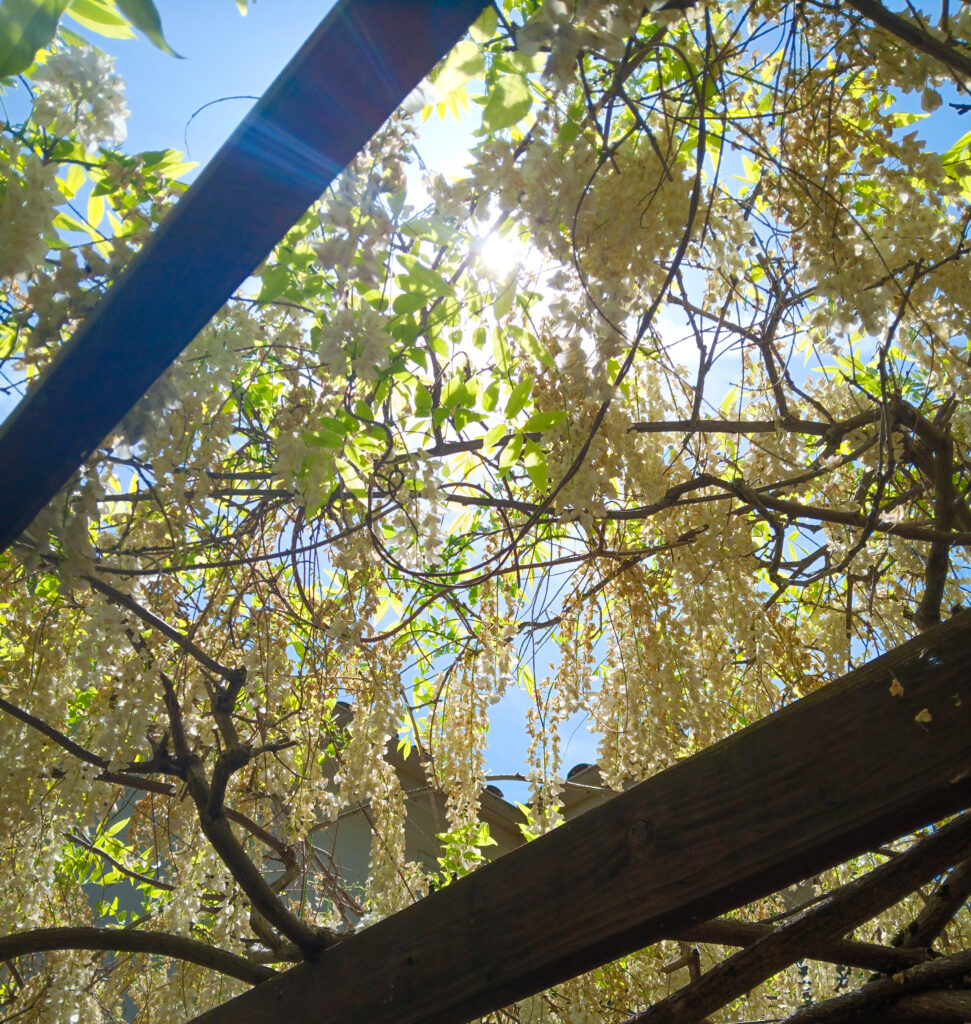
Wisteria hanging on the arbor in my backyard
In my next blog post, I’ll continue exploring the concept of home in more specific ways—so stay tuned. If this post resonated with you, feel free to comment, sign up for my newsletter, or share with a friend! Also if you live in the area, check out Dwelling: New Acquisitions at the Cantor Arts Center on Stanford’s campus. The exhibit runs until October 4, 2024.
In the meantime, I invite you to reflect on the questions below.
Peace be with you.
Reflection Questions / Journal Prompts:
- What does home mean to you?
- What does it look like, feel like, smell like, taste like?
- When you see the word “home,” what do you imagine?
- What is your definition of home? Would you add to or change mine?
- What are some ways you can feel more at home where you are now?
*Note: all photos in this blog are taken and owned by me unless explicitly mentioned*

Love it! Can’t wait for part 2